Every wine nation inherits something and invents something.
South Africa inherited Muscat, fortified wine traditions, Chenin Blanc and distillation from Europe. It invented Pinotage. It transformed Chenin Blanc from a workhorse grape into a fine-wine benchmark. It resurrected Vin de Constance from extinction. And in places like Calitzdorp, it turned Portuguese varieties and Port traditions into something unmistakably South African.
Strauss & Co’s latest Heritage, Sweet Wines, Ports, Brandy & Spirits auction is effectively a catalogue of those stories. More than a sale, it reads like a condensed history of South African wine.
While auctions are often viewed through the lens of rarity and value, they also reveal something deeper: What a country chooses to preserve. Taken together, the bottles in this sale form a compressed history of South African wine, spanning centuries of inheritance, experimentation, reinvention and ambition, and international counterparts for comparison.
The question of what constitutes truly Cape wine has occupied some of South Africa’s most influential winemakers for decades.
Chenin Blanc: The Story of Reinvention
When Chris Alheit and his friend Danie Carinus attended a tasting of Eben Sadie’s Priorat wines in 2008, they left stunned. The wines were unlike anything they expected. Honest, characterful and so deeply rooted in place that they could only have come from one corner of Spain. The drive home was mostly silent.
Eventually Carinus broke it. “Jis boys, wat gaan ons nou doen?”
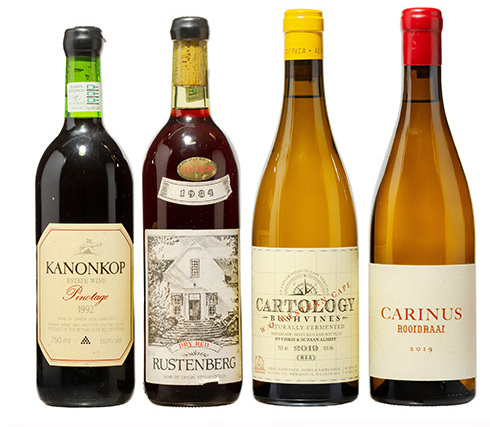
The question was not really about Priorat. It was about South Africa. How do you create wines that could only come from here? Part of the answer sits in this auction in the form of six consecutive vintages of Alheit Vineyards Cartology.
When Chris and Suzaan Alheit released the first Cartology in 2011, old-vine Chenin Blanc occupied a very different place in the South African imagination.
Today, the wine stands among the defining bottles of modern Cape wine, helping transform Chenin Blanc from a productive workhorse into one of the country’s most celebrated fine wine categories.
The same story can be found in the Sadie Family Skurfberg 2019, sourced from an isolated mountain vineyard planted more than 80 years ago. Awarded a perfect 100 points by Tim Atkin MW, the wine represents more than critical acclaim. It is the culmination of decades spent searching for vineyards capable of expressing a distinctly Cape identity.
Eben Sadie once explained his philosophy simply: “I’m not building a contemporary building. I’m building a Cape building. I’m making Cape wine.”
That pursuit of identity has become one of the defining narratives of South African wine in the 21st century. More than a sale, it reads like a condensed history of South African wine.
Pinotage: The Story of Invention
And if Chenin Blanc represents reinvention, Pinotage represents invention itself.
Created in Stellenbosch in 1925 through the crossing of Pinot Noir and Cinsault, Pinotage remains the only internationally recognised grape variety developed in South Africa. Few producers have done more to establish its reputation than Kanonkop. The collection offered in this auction stretches from the recorked 1992 vintage to more recent releases, including the celebrated 1993 Cape Winemakers Guild bottling and the 2006 Black Label Pinotage.
There is a certain irony in the fact that Paul Sauer, the politician after whom Kanonkop’s flagship Bordeaux blend is named, reportedly drank Tassenberg, Angelica and Château Libertas rather than fine wine. He had little patience for wine snobbery. Yet the wines produced on the estate that bears his legacy would become some of South Africa’s most sought-after collectables. Over time, Kanonkop became the standard-bearer for Pinotage’s fine wine ambitions. More importantly, they helped prove that a grape once dismissed as provincial could earn a place among the world’s finest wines.
Browse the Cape Heritage Lots here.
Yet long before Chenin Blanc became the country’s flagship white grape, and Pinotage started asserting its worth, before the Swartland revolution and before the old-vine movement, there was another wine that carried South Africa’s reputation to the world.
Vin de Constance: The Story of Resurrection
Vin de Constance.
The sweet wines of Constantia were among the most sought-after luxury goods of the eighteenth and nineteenth centuries. They appeared in the cellars of European royalty, were referenced by Jane Austen and famously accompanied Napoleon Bonaparte during his exile on St Helena. Austen famously prescribed it for a disappointed heart. Then, somewhat ironically, it disappeared. Production ceased in the late nineteenth century and for almost a century one of South Africa’s most famous wines existed only in books, auction catalogues and memory. Its resurrection in 1986 remains one of the most significant acts of recovery in modern wine history.
The Vin de Constance collection offered in this sale, stretching back to that maiden vintage, is therefore more than a collection of rare bottles. It represents the revival of a wine that once defined the Cape’s global reputation and continues to do so today. Fittingly, the sale places Vin de Constance alongside Château d’Yquem, one of the few sweet wines with a comparable place in wine history.
Current winemaker Matt Day recently described the recorked 1986 vintage as one of the finest bottles of Vin de Constance he has ever tasted. Forty years on, the wine remains both a historical artefact and a living thing, still evolving, still telling its story.
Though the sweet wine category extends beyond Constantia.
The first four releases of Mullineux Olerasay, among the most ambitious sweet wine projects ever undertaken in South Africa, demonstrate that the category remains fertile ground for innovation. Inspired by the solera systems of Jerez, Olerasay represents another distinctly South African act of reinterpretation. And while sweet wines may occupy a smaller share of modern drinking habits, they continue to occupy an outsized place in South Africa’s wine heritage.
Browse the Sweet lots here.
Port & Brandy: The Story of Adaptation
The same can be said for fortified wines.
When I visited Portugal’s Douro Valley two years ago, I was struck by how seriously the Portuguese collect their own history. Ancient Ports, forgotten vineyard parcels and bottles that had survived wars, revolutions and changing fashions were treated not as curiosities but as cultural artefacts.
South Africa’s fortified wine story is different, yet no less compelling. In the Klein Karoo, generations of producers transformed Portuguese varieties and traditions into something uniquely local. Families like the Nels of Boplaas and De Krans and others proved that grapes like Tinta Barocca and Touriga Nacional, erroneously planted in what was to become South Africa’s unofficial Port Capital, Calitzdorp, could thrive under South African skies, creating a category that today forms an important chapter of the country’s wine history.
The extensive collection of KWV, Monis and Boplaas Ports offered here spans nearly a century, preserving bottles that speak to an era when fortified wines occupied a central place in South African wine culture.
Browse the Port lots here.
The same thread runs through the brandy and spirits session. For much of the twentieth century, brandy was not a niche category but one of the foundations of the Cape wine economy. Long before consumers debated old-vine Chenin Blanc or single-site Syrah, generations of South African producers distilled wine into spirits that became part of the country’s cultural fabric (and arguably still do).
Browse the Spirits and Brandy lots here.
Seen together, the categories represented in this sale begin to feel less like separate collections and more like chapters in a single story.
Chenin Blanc tells the story of reinvention, Pinotage tells the story of invention. Vin de Constance tells the story of resurrection. Port and brandy tell the story of adaptation.
Collectively, they chart South Africa’s long journey from colonial outpost to one of the world’s most distinctive wine-producing nations. Which, with their international counterparts, offers a unique opportunity to view them in juxtaposition.
Collectors often speak about provenance, rarity and value. Yet the greatest bottles tend to survive for another reason entirely. They tell stories worth preserving. The wines in this auction represent some of the most important stories South African wine has ever produced. Some were inherited from elsewhere. Others could only have happened here. Together they form something rarer than a collection of bottles. They form a record of how a wine culture established itself.
The Cape Heritage, Sweet Wines, Ports, Brandy & Spirits Timed Online Auction closes at one-minute interviews from 6pm on 22 June.
For more articles like this click here.
If you enjoyed this website then check out our other sites: Wedding and Function, Home Food and Travel, Kids Connection, Boat Trips for Africa, Bargain Buys, Business Link.
Need help with your online marketing then visit Agency One.